uni's digital archive
After Work, After Control
Virtue and Human Agency in the Age of Automation
from 01/05/2026, by uni — 10m read
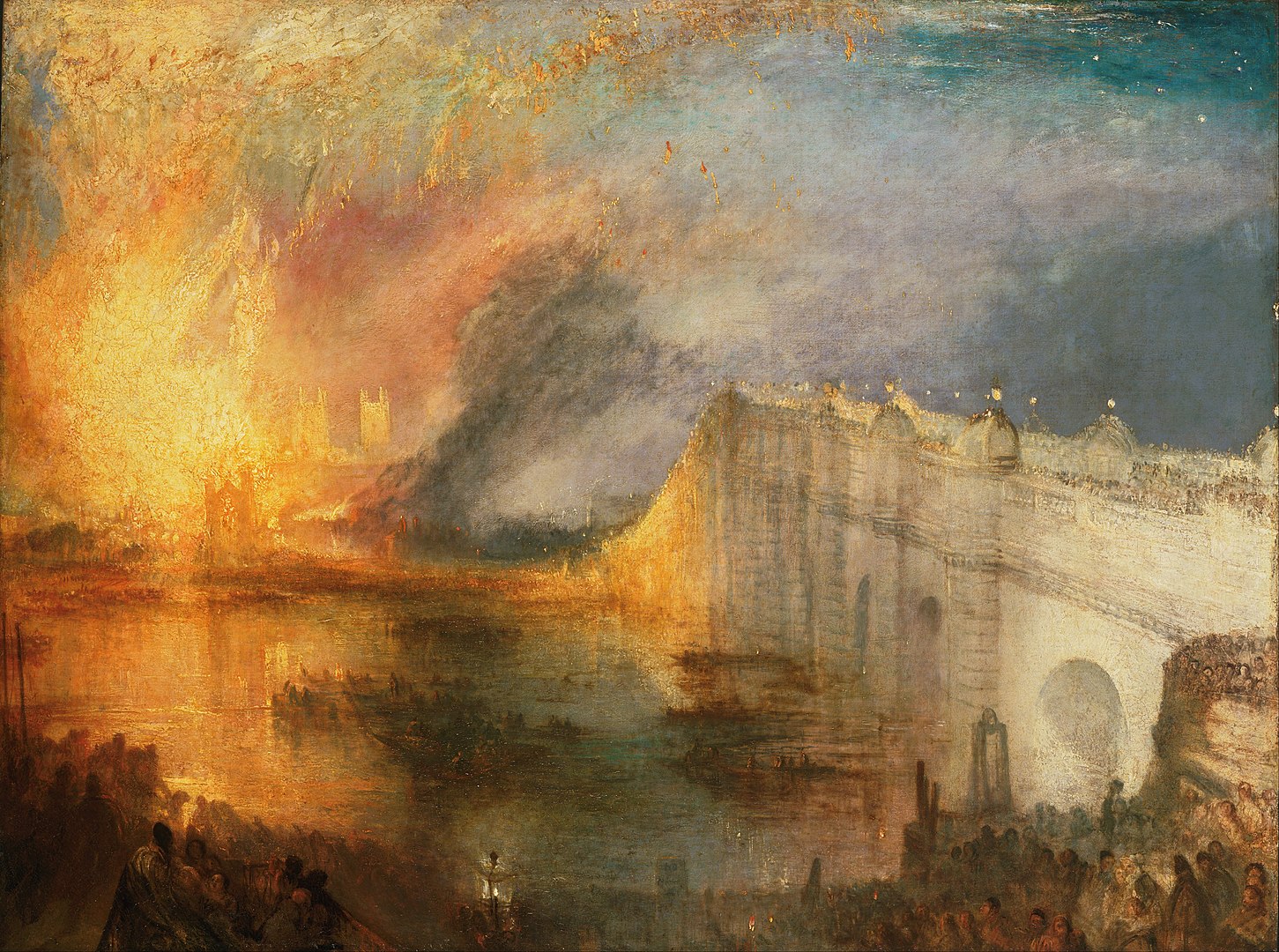
Figure 1: The Burning of the Houses of Lords and Commons (Version 1) (1834)
Virtue & Labor
Classical philosophy did not ask whether life should be busy. It asked whether life should be well lived. For Aristotle, the central human aim was eudaimonia, a term too often flattened into "happiness," but better understood as flourishing across the span of a life. This flourishing was not accidental, nor granted by fortune, but achieved through the cultivation of virtue. Virtue, or aretē, meant excellence in function. A human being flourishes when reason governs desire, when choice is deliberate, and when action coheres with an intelligible sense of the good. Within this framework, labor was never sacred. It was instrumental. Work mattered only insofar as it supported the formation of one's character and enabled participation in a fuller human life.
This point is often missed by modern readers because contemporary society quietly inverted this relationship. Work ceased to be a means and instead became an identity. Productivity replaced character as the primary measure of worth. One's moral standing became entangled with output, efficiency, and visible contribution. From a classical perspective, this is a category error. Aristotle explicitly worried that lives consumed entirely by necessity left no room for contemplation, friendship, or civic engagement. Labor that consumes the whole of life gradually erodes the conditions under which virtue can take root. The tragedy is not that people work, but that work is asked to bear the full weight of meaning.
This tension becomes clearer when viewed through the lens of absurdism. Albert Camus begins from a different premise but arrives at a similar demand. Humans seek meaning in a universe that offers none by default. This mismatch, the absurd, cannot be resolved intellectually. It can only be lived. Camus rejects resignation and illusion alike, arguing instead for lucidity and defiance. Meaning emerges through action rather than revelation. While Camus strips the cosmos of purpose, he preserves human responsibility. In this manner, absurdism does not negate virtue but relocates it. The task is no longer to align oneself with an objective order, but to live deliberately despite its absence.
The danger emerges when neither virtue nor revolt is cultivated. A life structured entirely by external demands produces compliance without depth. A life freed from demands but lacking orientation collapses into aimlessness. Historically, labor imposed structure by necessity. It forced engagement with consequence, discipline, and time. But necessity is a blunt teacher. When it weakens without replacement, individuals are left untrained for freedom itself. This is the fault line of modern life: unprecedented autonomy paired with underdeveloped moral formation. A fulfilling life cannot be reduced to comfort or self-expression alone. It requires friction, commitment, and the capacity to choose well over time.
This inquiry is not Marxist in orientation, nor is it primarily economic. It does not ask who owns labor, but what becomes of human activity when its meaning is either overburdened or erased. Here, Hannah Arendt offers a decisive clarification. In The Human Condition, she distinguishes labor, which sustains biological life, from work, which builds a durable world, and from action, which creates meaning through speech, judgment, and shared presence. Modern society, she argues, collapses these distinctions, elevating labor while crowding out action. The result is a world that is endlessly busy yet existentially thin. Read alongside classical virtue, Arendt sharpens the central claim of this section: a fulfilling life does not arise from labor alone, nor from leisure without form, but from the preservation of spaces where human beings can act, judge, and cultivate the capacities required to live deliberately.
Artificial Intelligence & Kaczynski
Artificial intelligence complicates this picture by destabilizing the very conditions under which those capacities have traditionally been exercised. Earlier technological shifts altered the conditions of work without calling human judgment itself into question. AI threatens something more fundamental. It intervenes at the level of reasoning, prediction, and decision-making itself. Tasks once bound to deliberation are now rendered as optimization problems. The question this raises is not whether humans will remain employed, but whether they will remain necessary as moral agents within the systems they inhabit. When judgment can be automated, virtue loses the environmental pressures that once made it unavoidable.
It is at this limit that Ted Kaczynski becomes analytically useful, despite the moral disqualification imposed by his actions. Stripped of violence and rhetoric, his critique is fundamentally psychological. He argued that advanced technological systems inevitably subordinate human values to systemic efficiency. In practice, human behavior increasingly conforms to the demands of such systems rather than directing them. Goals are preselected, consequences abstracted, and participation reduced to procedural compliance. The individual remains active, but only symbolically. Human activity continues, but its orientation is increasingly defined elsewhere. One does not act toward ends one has chosen, but toward outputs the system requires.
Kaczynski's concept of "surrogate activities" names this condition with uncomfortable clarity. As necessity recedes, humans construct artificial struggles to simulate purpose. Hobbies, competitions, symbolic achievements, and abstract status hierarchies proliferate, not as expressions of freedom, but as compensations for its absence. This diagnosis resonates sharply with contemporary life, where meaning is often pursued through metrics detached from survival or consequence. Yet Kaczynski's conclusion is too rigid. He assumes that virtue requires externally imposed necessity, that struggle must be coercive to be formative. In doing so, he mistakes contingency for essence.
Classical virtue ethics offers a corrective. Aristotle did not locate virtue in deprivation or survival pressure, but in habituated choice. Excellence was cultivated through practice, guided by reason, and oriented toward a conception of the good life. AI does not abolish this possibility, but it removes the excuse of inevitability. When systems no longer require human judgment, the cultivation of virtue becomes optional rather than enforced. This is precisely why the challenge is so severe. Virtue must now be chosen without compulsion. It must be sustained without necessity. The disappearance of struggle does not negate virtue, but it exposes whether it was ever valued for its own sake.
In this sense, artificial intelligence does not represent a moral catastrophe by default. It represents a test. A society that equates meaning with productivity will experience automation as existential collapse. A society that understands virtue as the capacity to live deliberately may experience it as an ethical reckoning. Kaczynski correctly sensed that technological systems threaten to hollow out agency. Where he erred was in concluding that regression was the only remedy. AI does not force humanity into irrelevance. It confronts humanity with a choice it has long deferred: whether to remain agents in a world that no longer demands it, or to surrender authorship and become passive participants in systems that function perfectly well without us.
Figure 2: The Burning of the Houses of Lords and Commons (Version 2) (1834)
Turner & Chaos
J. M. W. Turner's The Burning of the Houses of Lords and Commons captures a moment when human confidence in its own structures falters under forces it can no longer command. On its surface, the painting records a historical event: the 1834 fire that destroyed the old Palace of Westminster. But Turner was less concerned with documenting events than with revealing the conditions of modernity they exposed. What he paints here is not political failure, but institutional vulnerability. The seat of British governance, embodiment of continuity, reason, and authority, is rendered weightless before flame and reflection. Order does not collapse through malice or rebellion. It simply proves combustible.
Turner's lifelong engagement with the sublime is essential context. Long before this work, he depicted storms, shipwrecks, and avalanches, scenes in which nature dwarfs human intention. What changes in the industrial era is not his aesthetic language, but its application. By the 1830s, the sublime was no longer confined to mountains or seas. Steam engines, railways, factories, and urban infrastructure possessed the same overwhelming force. In Turner's work, technology does not oppose nature; it joins it. Both exceed human scale. Both induce awe and anxiety simultaneously. Beyond transforming labor, the Industrial Revolution exposed the fragility of humanity's confidence in its own built order.
The fire at Westminster offered Turner a convergence of these themes. The destruction is spectacular, almost beautiful, and this beauty is deeply unsettling. Flames illuminate the river, architecture dissolves into light, and the crowd gathers not in terror but in fascination. This spectatorship is crucial. The figures lining the Thames are rendered as witnesses rather than participants in the transformation before them. Their posture suggests neither resistance nor despair, but attentiveness. Control has already been lost. What remains is presence. Turner refuses to moralize the event because moral explanation would diminish its meaning. The painting insists instead on contingency: the revelation that structures assumed permanent are provisional, and that their collapse does not announce the end of the world.
Recontextualized within our contemporary concerns, Turner's painting becomes uncannily prescient. Just as industrial modernity displaced human muscle, artificial intelligence threatens to displace human cognition. In both cases, systems emerge that operate according to internal logics indifferent to human virtue. The danger is not domination by a conscious force, but displacement by scale and complexity. AI, like fire, is not a god. It does not judge, intend, or revolt. It executes. When such systems exceed human comprehension, humans risk becoming what Turner's figures already are: spectators to processes they initiated but no longer meaningfully guide.
Yet Turner does not offer nihilism, and neither need we. The painting's quiet insistence is that meaning does not reside in control, permanence, or optimization. It resides in orientation. When inherited structures burn, virtue cannot consist in mastery over systems that no longer answer to us. It must consist in lucidity, judgment, and the refusal to become passive. Turner shows us a civilization momentarily stripped of its illusions. What follows is undecided. Whether chaos becomes decay or renewal depends not on what replaces the building, but on the kind of agents who remain standing on the riverbank, capable of choosing how to live once the flames subside.